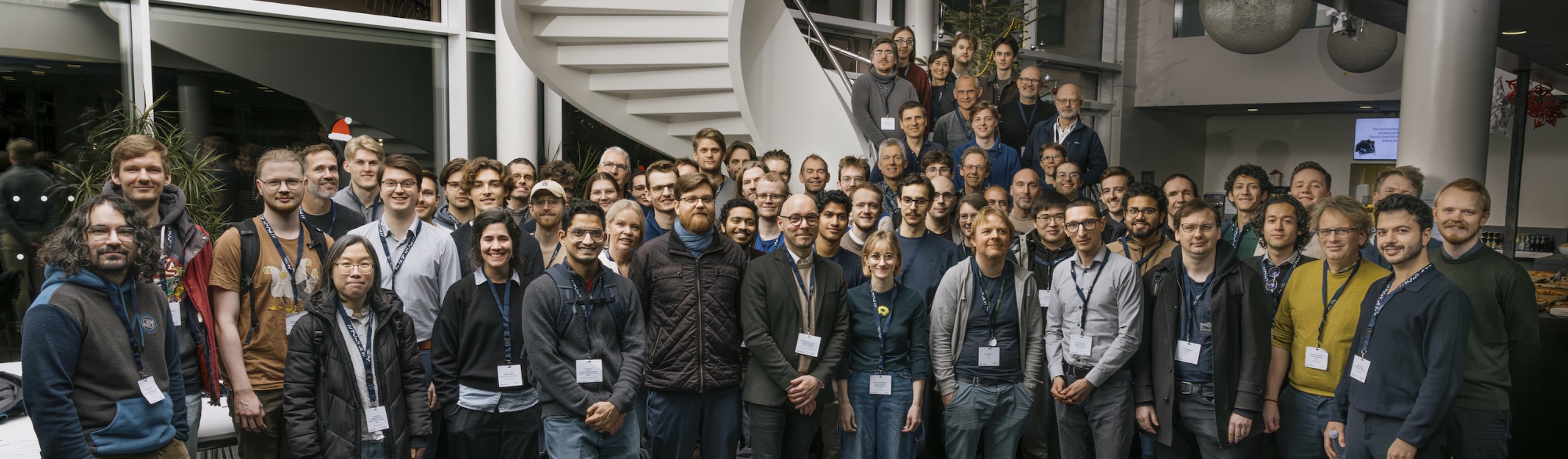
QCA Connect, formerly the QCA Annual Meeting, is the annual meeting point for the Aarhus quantum community. The event brings together researchers, early-career scientists, students, companies, national initiatives and other actors from the wider quantum ecosystem for a full day of scientific exchange, networking and new connections across disciplines and sectors.
Poster abstract submission deadline: 15 November 2026 (Extended from 2 November 2026. Read more about the poster session below)
General registration deadline: 1 December 2026
Registration is now open. Participation is free of charge, but registration is required.
We warmly encourage participants to submit an abstract for the poster session.
The poster abstract deadline has been extended from 2 November to 15 November 2026.
If you would like to present a poster, please register and submit your poster title and abstract through the registration form no later than 15 November 2026.
Abstract format: Please submit a short abstract of maximum 1,500 characters including spaces. The abstract should briefly describe the background, aim, and main focus of the work. The submission form does not support figures or tables, so please provide text only.
Posters will be selected by the QCA Seminar Committee based on the submitted abstracts. All applicants will be notified in sufficient time to prepare and print their poster before the meeting.
An audience poster prize will be awarded during QCA Connect.
Laura García Alvarez
Researcher, Applied Quantum Physics, Chalmers University of Technology
Laura García Alvarez works on theoretical quantum computing and quantum information, with research spanning quantum algorithms, continuous-variable quantum computing and the resources required for quantum advantage. Her work also includes applications of quantum algorithms and the study of quantum dynamics and synchronization. She is part of the Wallenberg Centre for Quantum Technology (WACQT) at Chalmers University of Technology. research.chalmers.se
Talk title and description to be announced.
The QCA Incubator supports new interdisciplinary collaborations across Aarhus University within quantum science and technology. It is designed to help early-stage ideas develop through matchmaking, strategic sparring, access to relevant expertise and infrastructure, and preparation for future external funding and collaboration.
In this session, the two teams selected for the 2026–27 QCA Incubator will introduce their projects, the collaborations they are building and the directions they plan to develop over the coming year.
1. Quantum Circuit Optimization through Group Theory and Buildings
The team explores a new geometric approach to quantum circuit optimisation, bringing together group theory, the theory of buildings and computer science. The project focuses on minimising costly CX gates by translating circuit optimisation into a geometric problem and aims to develop new mathematical methods with potential algorithmic applications.
2. QuSPIN – From Altermagnetic Quantum Materials to Quantum-Enabling Spin Technology
QuSPIN explores how emerging altermagnetic materials could enable new spin-based quantum technologies. The team will connect theoretical modelling, materials exploration and experimental pathways, with potential directions including quantum sensing, spin-based information processing, quantum interfaces and magnonics.
In this session, we spotlight two researchers from the Aarhus quantum community who have received Sapere Aude: DFF-Research Leader grants from Independent Research Fund Denmark (DFF) this year.
Rosana Turtos and Christian Frydendahl will present their research projects and share their plans and ambitions for the coming years. The session offers an opportunity to learn about their work and find inspiration for new ideas and collaborations across the QCA community.
Rosana Turtos, Associate Professor, Department of Physics and Astronomy, Aarhus University
Christian Frydendahl, Assistant Professor, Department of Physics and Astronomy, Aarhus University
Short talks by PhD students and early-career researchers from different departments and faculties.
Raphael Seidel
Staff Engineer, IQM Quantum Computers
Raphael Seidel works on quantum software and programming, with a particular focus on making quantum programming more accessible and scalable. He is one of the driving forces behind Qrisp, an open-source high-level quantum programming framework, and works on integrating quantum software with IQM’s quantum computing platform and hardware.
Talk title and description to be announced.
Three contributions of approximately 20 minutes each:
Nick Volet
Associate Professor, Department of Electrical and Computer Engineering, Aarhus University
Mark Kamper Svendsen
Novo Nordisk Foundation Quantum Computing Programme (NQCP) / Quantum Foundry Copenhagen
Kvantify





Photos will be taken during the event and may be used in AU-related communication, including future promotion of QCA Connect and broader communication about Quantum Campus Aarhus activities. If you do not wish to be photographed, please inform the photographer or one of the event organisers on the day.
Lise Refstrup Linnebjerg Pedersen, QCA Coordinator, Aarhus University, (lrlp@au.dk)
