
Two interdisciplinary teams selected for the first QCA Incubator
Two interdisciplinary teams have been selected for the first QCA Incubator. The projects bring together expertise across mathematics, computer science, engineering, and physics to explore new approaches to quantum challenges. Both teams will now enter a one-year process supported by Quantum Campus Aarhus.
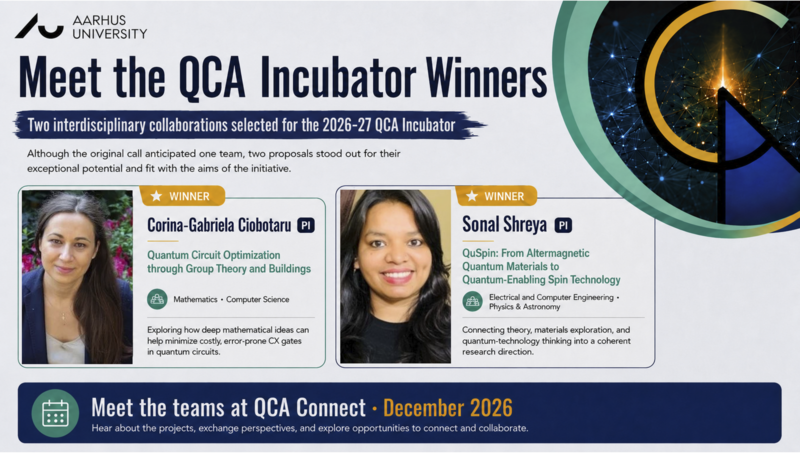
Quantum Campus Aarhus (QCA) has selected two interdisciplinary collaborations for the first QCA Incubator – a new initiative designed to help promising quantum-related ideas develop into structured collaborations with concrete outcomes.
The original call anticipated selecting one team, but following the evaluation, the QCA Leadership Team decided to select two. Both proposals stood out for their interdisciplinary potential, expected impact, feasibility within the one-year timeframe, and the clear added value that QCA can bring to the collaborations.
Quantum Circuit Optimization through Group Theory and Buildings
Co-led by Corina-Gabriela Ciobotaru from the Department of Mathematics and Daniel Gratzer from the Department of Computer Science, the project also brings together Johannes Carl Droschl, Jens Emil Christensen and Esben Kaae Bonnerup in a team spanning mathematics and computer science.
The team will explore whether tools from group theory and the geometry of spherical buildings can provide new approaches to quantum circuit optimization – specifically, to minimizing costly and error-prone CX gates. The main planned outcome is a joint research article establishing new connections between modern mathematics and quantum computing.
QuSPIN: From Altermagnetic Quantum Materials to Quantum-Enabling Spin Technology
Led by Sonal Shreya from the Department of Electrical and Computer Engineering, QuSPIN brings together Kishori Lal and Yusuke Imai from Electrical and Computer Engineering and Jill Miwa from the Department of Physics and Astronomy.
QuSPIN will explore altermagnetic materials as a possible platform for future quantum-enabling spin technologies, connecting theory and simulation with materials exploration and experimental pathways. The primary outcome will be a funding-ready interdisciplinary research proposal plan.
From selection to collaboration
The two teams will now enter a one-year QCA Incubator process. Rather than providing research funding, QCA will support the collaborations through facilitation, strategic matchmaking, connections to relevant infrastructure and external partners, feedback and proposal stress-testing, visibility, and regular follow-up. The aim is to help each team develop its collaboration and reach one concrete outcome within the year.
Each team will begin with a kick-off meeting with the QCA Leadership Team to discuss its ambitions, needs and priorities and shape the support provided during the Incubator process.
Selecting two teams also creates an additional opportunity for interdisciplinarity. During the year, the teams will meet to present their work, exchange perspectives and provide feedback to one another – creating opportunities to learn across two very different approaches to quantum research.
The wider QCA community will get an opportunity to meet the teams and hear more about their projects when they are featured at QCA Connect in December 2026.