A race against resistance
Gathered at Folkemødet on Bornholm in mid-June, an expert panel met aboard AURORA—Aarhus University’s state-of-the-art research vessel—to confront one of the most urgent global health threats: antimicrobial resistance (AMR).


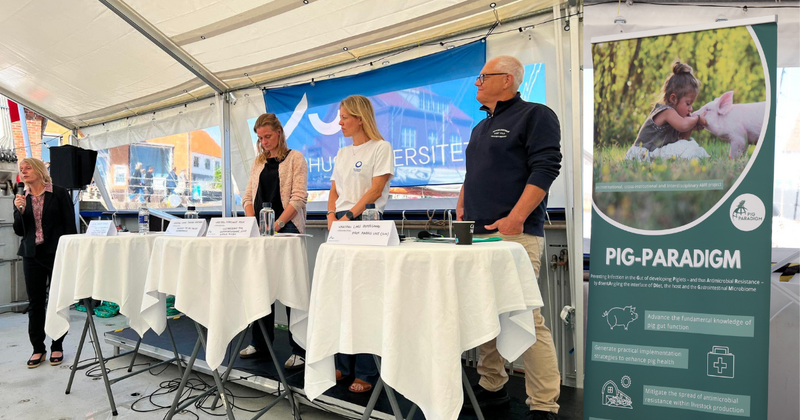
Led by Professor Charlotte Lauridsen, coordinator of the PIG-PARADIGM project and head of the De-partment of Animal and Veterinary Sciences, Aarhus University, TECH, the session unpacked the scale and complexity of the crisis, while pointing to the need for bold, cross-disciplinary solutions to stay ahead of it.
The expert panel consisted of Professor Lars Østergaard from Aarhus University (SUND), Marianne Holm, Vice President at the Novo Nordisk Foundation and Mette Rørbæk Gantzhorn, Chair of the Danish Veterinary Association. A strong turnout of enthusiastic attendees set the stage.
From the outset, Charlotte Lauridsen emphasized that while the project focuses on pig production, the issue at hand extends far beyond agriculture. AMR is a shared global threat that connects animals, humans, and the environment in what is increasingly understood as a One Health challenge.
Antibiotics have fundamentally shaped modern healthcare, enabling life-saving treatments that we often take for granted. As Professor Lars Østergaard from Aarhus University explained during the panel: “Antibiotics are a safety net throughout our entire healthcare system.”
He pointed out that many patients do not die from the cancer itself, but rather from the infections that arise because cancer treatment increases the risk of infections due to weakened immune systems: “If we cannot treat those infections because of antibiotic resistance, we lose the safety net that exists in cancer treatments.”
A growing global crisis
AMR is not confined to hospitals or even national borders—it is a global issue driven by how antibiotics are used across sectors and countries. Marianne Holm highlighted the scale and urgency: “We are dealing with a global problem. In many parts of the world, antibiotics are used without sufficient control, and resistance is already causing significant mortality.”
Marianne Holm also pointed to a worrying imbalance in research investment: “There are around 1,200 cancer drugs in development—but only about 40 new antibiotics in the pipeline. That is a serious mismatch.”
This lack of innovation means that as bacteria evolve, the tools available to fight them are not keeping pace.
One problem across humans and animals
A key theme throughout the discussion was the interconnected nature of AMR. Resistant bacteria do not respect boundaries between species or systems.
As Lars Østergaard explained: “Resistant bacteria spread much like other infections—through contact, proximity, and increasingly also through environmental pathways such as dust.”
This means that antibiotic use in one area—whether in hospitals or agriculture—can influence resistance patterns elsewhere.
Mette Rørbæk Gantzhorn stressed the shared stakes: “We must ensure that we do not return to a time where both humans and animals die from simple infections like diarrhea or pneumonia.”
Agriculture: part of the challenge—and the solution
Pig production, particularly in Denmark, is often highlighted in discussions on antibiotic use. While Denmark has relatively low usage compared to many countries, challenges remain in intensive production systems where disease pressure can be high.
Mette Rørbæk Gantzhorn explained the ethical balance: “If we simply stop using antibiotics, we create a serious animal welfare issue. Animals would suffer and die from infections.”
This underscores an essential point: reducing antibiotic use is not about elimination, but about smarter, more targeted use combined with better prevention.
PIG-PARADIGM: Innovating through prevention
This is precisely where the PIG-PARADIGM project plays a vital role, Charlotte Lauridsen added. The project investigates how nutrition and gut health can strengthen pigs’ resilience to disease.
“We investigate how diet and nutrition can influence gut bacteria and build robustness in pigs.”
By improving gut microbiota and overall health, the project aims to reduce the need for antibiotics at its source. This preventive approach is not just relevant to pig farming—it reflects broader strategies that can also be applied in human health.
Across the panel, there was strong agreement that prevention is the most powerful tool in combating AMR.
Marianne Holm emphasized this clearly: “The best way to avoid infection is to prevent it in the first place.”
This includes:
Better hygiene and infection control
Vaccination strategies
Improved animal welfare and living conditions
Advanced diagnostics to ensure antibiotics are only used when necessary
Professor Lars Østergaard summarized the principle succinctly: “We must use as little antibiotics as possible—but as much as necessary.”
Beyond prevention, the panel stressed the urgent need for innovation. This includes developing new antibiotics, but also alternative solutions such as vaccines, probiotics, and improved diagnostics. Equally critical is global cooperation. AMR cannot be solved by individual countries acting alone.
“We need to develop solutions—and ensure they can be scaled and applied worldwide,” Marianne Holm noted.
Denmark, with its strong monitoring systems and relatively responsible antibiotic use, has the opportunity to act as a model—but it must also help drive global change.
Conclusion: A shared responsibility
The discussion at Folkemødet made one thing clear: antimicrobial resistance is not just a problem for hospitals, farmers, or scientists. It is a universal challenge that affects everyone. Without effective antibiotics, modern medicine, food production, and public health systems are at risk. Yet through initiatives like PIG-PARADIGM, there is reason for optimism.
By focusing on prevention, investing in innovation, and working across sectors and borders, it is possible to confront AMR before it becomes an irreversible crisis.