Vision & Mission
Our Vision
LESIA envisions a future in which energy storage technologies are no longer constrained by poorly controlled interfaces, empirical design rules, and limited understanding of microscopic processes. Instead, we aim to establish a new paradigm in battery research and development—one in which surfaces and interfaces are deliberately engineered, rather than merely tolerated, to actively enhance performance, stability, and safety.
In today’s batteries, many of the most critical phenomena—such as ion transport, interfacial reactions, degradation, and mechanical failure—originate at surfaces. Yet these regions remain among the least understood and least controlled. LESIA seeks to change this by placing surface and interface engineering at the centre of battery design.
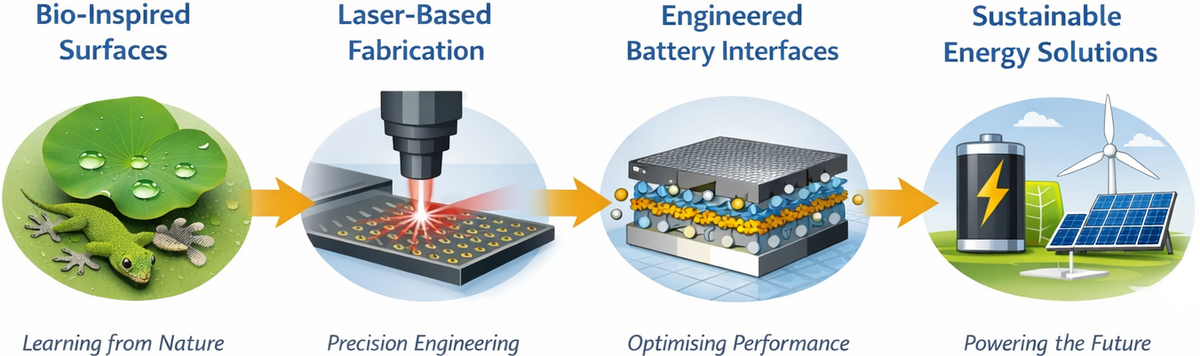
Inspired by functional surfaces found in nature and enabled by advanced laser-based fabrication technologies, we aim to create battery components whose micro- and nanoscale architectures are not incidental, but purposeful. Our vision is to move beyond incremental improvements and towards genuinely transformative strategies for energy storage.
By integrating fundamental science, advanced manufacturing, and real-time characterisation, LESIA aspires to contribute to Europe’s leadership in sustainable energy technologies and to support the transition towards a climate-neutral society.
Our Mission
LESIA’s mission is to develop, understand, and demonstrate bio-inspired, laser-engineered surfaces and interfaces for next-generation batteries, while simultaneously training a new generation of interdisciplinary researchers capable of working across traditional scientific boundaries.
This mission is realised through five interconnected goals:
1. Redefining how battery interfaces are designed
Rather than relying on conventional trial-and-error surface treatments, LESIA develops systematic, knowledge-driven design strategies for functional surfaces. Drawing inspiration from biological systems, we explore how hierarchical architectures, tailored chemistry, and controlled topology can regulate electrochemical processes.
2. Creating new fabrication paradigms
The project advances laser interference lithography and its integration with electrochemical processing and self-assembly to enable scalable, precise, and versatile surface engineering. These approaches allow us to fabricate highly ordered micro- and nanostructures that are difficult or impossible to achieve with conventional methods.
3. Understanding interfaces in operation
LESIA places strong emphasis on operando and non-destructive characterisation. By observing how interfaces evolve in real time during battery operation, we aim to reveal the fundamental mechanisms that govern ageing, failure, and performance. This knowledge feeds directly back into improved design.
4. Bridging disciplines and sectors
The challenges addressed by LESIA lie at the intersection of surface science, laser physics, electrochemistry, materials science, and advanced microscopy. The project deliberately integrates these disciplines, fostering cross-fertilisation of ideas and methods that would not emerge in isolated research environments.
5. Training future scientific leaders
As a Marie Skłodowska-Curie Staff Exchanges project, LESIA places training, mobility, and knowledge transfer at its core. Through international secondments, joint supervision, and dedicated workshops, we equip researchers with both deep technical expertise and transferable skills, preparing them for leadership roles in academia, industry, and policy.
Long-Term Perspective
LESIA is designed not as a one-off research initiative, but as the foundation of a long-term collaboration network. By establishing shared methodologies, open knowledge frameworks, and durable partnerships, we aim to create a self-sustaining ecosystem for continued innovation in surface-engineered energy materials.
Ultimately, our mission extends beyond batteries. The concepts, tools, and design philosophies developed in LESIA are expected to influence a wide range of technologies where surfaces and interfaces play a decisive role, from catalysis and sensing to biomedical devices and photonics.