Scientific Concept
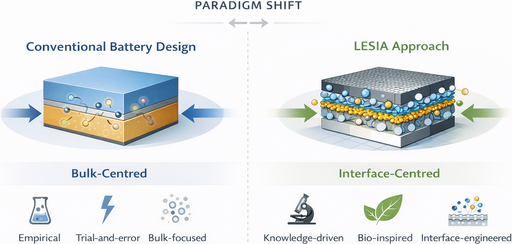
Engineering battery performance from the interface outwards
At the core of LESIA lies a fundamental scientific premise: the most critical processes in batteries occur not in the bulk of materials, but at their surfaces and interfaces. These regions govern how ions move, how reactions proceed, how materials degrade, and how mechanical stresses accumulate. Yet, they remain among the least controlled and least understood aspects of battery design.
Traditional approaches to battery development often focus on discovering new bulk materials or modifying existing chemistries. While this has led to incremental improvements, many persistent limitations—such as dendrite formation, interfacial instability, poor cycling stability, and safety risks—continue to originate at the nanoscale, where surfaces meet electrolytes and where reactions are highly localised.
LESIA shifts this paradigm by placing surface and interface engineering at the centre of battery design.
Learning from Nature
Natural surfaces exhibit extraordinary functionalities that arise not from their chemical composition alone, but from their hierarchical structure, topography, and local chemistry. Examples include:
- The lotus leaf, whose micro- and nanostructures create extreme water repellency
- Gecko feet, whose nanoscale fibrils enable reversible adhesion
- Shark skin, whose surface texture reduces drag and inhibits fouling
These systems demonstrate how structure and function are intrinsically linked across multiple length scales.
LESIA adopts this bio-inspired philosophy to design battery interfaces that do not merely exist as passive boundaries, but actively regulate electrochemical processes. By controlling surface geometry, porosity, roughness, and chemistry, the project aims to guide ion transport, stabilise reactions, mitigate degradation, and accommodate mechanical strain.
Structure–Function Relationships
A central scientific objective of LESIA is to establish robust structure–function relationships for battery interfaces. This involves understanding how specific surface features influence:
- Ion transport and diffusion
- Charge transfer kinetics
- Formation and evolution of interphases (SEI and CEI)
- Mechanical stability and stress relaxation
- Wetting behaviour and electrolyte infiltration
By combining systematic design with advanced characterisation, LESIA moves beyond empirical optimisation and towards predictive, knowledge-driven interface engineering.
Hierarchical and Multifunctional Surfaces
Rather than relying on single-scale modifications, LESIA focuses on hierarchical architectures—structures that combine features across multiple length scales, from the micrometre down to the nanometre.
Such surfaces can integrate multiple functionalities simultaneously, for example:
- Large-scale channels for rapid electrolyte transport
- Nanoscale confinement for controlled nucleation
- Chemical gradients for selective ion affinity
- Elastic architectures for mechanical resilience
This multifunctionality is essential for addressing the complex and often competing requirements of high-performance batteries.
From Observation to Design
Another defining aspect of the LESIA scientific concept is the tight coupling between observation and fabrication. Using operando and non-destructive characterisation tools, the project observes how interfaces evolve during real battery operation. These insights are then fed back into the design process, enabling continuous refinement of surface architectures.
This iterative loop—design, fabricate, observe, redesign—forms the backbone of LESIA’s scientific methodology.
Beyond Batteries
Although LESIA is focused on energy storage, its scientific contributions extend far beyond this application domain. The principles of bio-inspired surface engineering, hierarchical structuring, and function-driven design are relevant to a wide range of technologies, including catalysis, sensing, photonics, and biomedical devices.
By developing generalisable design frameworks rather than application-specific fixes, LESIA aims to contribute to a broader rethinking of how functional materials are conceptualised and engineered.