Methodology
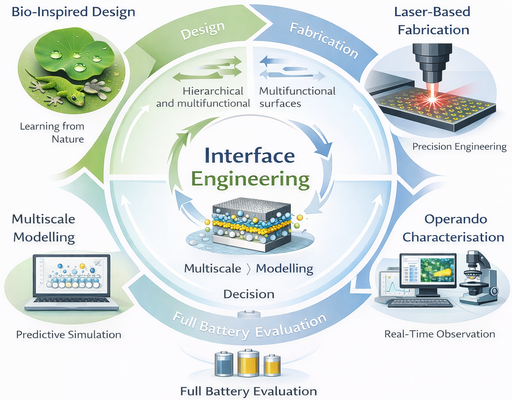
Integrating design, fabrication, and real-time understanding
LESIA adopts an integrated and iterative methodology that connects surface design, laser-based fabrication, and operando characterisation into a unified workflow. Rather than treating these stages as separate, the project links them through continuous feedback loops, ensuring that scientific insight directly informs material development.
This approach enables LESIA to move beyond empirical optimisation and towards predictive, knowledge-driven engineering of battery interfaces.
Bio-Inspired Design
The process begins with the systematic study of natural surfaces. Using advanced metrology tools, LESIA identifies how biological systems use hierarchical structures, local chemistry, and mechanical adaptability to achieve specific functions.
These observations are translated into design principles for battery interfaces. Multiscale modelling and simulation tools help predict how specific surface architectures influence ion transport, reaction kinetics, and mechanical stability.
Laser-Based Fabrication
LESIA develops advanced laser-based manufacturing routes to implement these designs with high precision and scalability.
A central technique is laser interference lithography (LIL), which enables the rapid patterning of large areas with highly ordered micro- and nanostructures. LESIA extends this method by integrating it with:
- Electrochemical deposition and etching
- Self-assembly processes
- In-situ laser ablation and deposition
This hybrid approach enables the fabrication of complex three-dimensional architectures that are not accessible with conventional methods.
Interface Engineering in Battery Components
The developed fabrication tools are applied directly to key battery components, including anodes, cathodes, current collectors, and separators. Rather than modifying these components after fabrication, LESIA integrates surface engineering into their formation.
This enables control over electrolyte wetting, ion flux distribution, interfacial stability, and mechanical stress relaxation—addressing key failure mechanisms at their origin.
Operando Characterisation
LESIA places strong emphasis on operando and non-destructive characterisation. Advanced microscopy and spectroscopy tools allow real-time observation of interfacial processes during battery operation.
By tracking how interfaces evolve under realistic conditions, the project uncovers the mechanisms that govern degradation, safety, and performance.