Training & Staff Exchanges
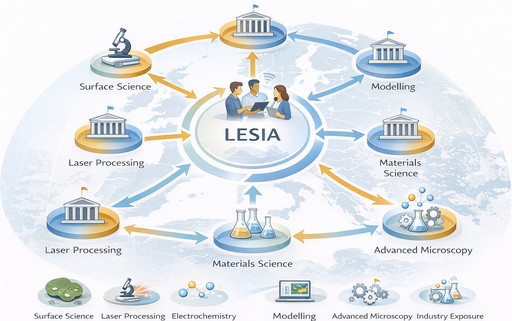
Developing interdisciplinary expertise through mobility and collaboration
LESIA is both a research and a training initiative. As a Marie Skłodowska-Curie Staff Exchanges project, it places international mobility, knowledge transfer, and interdisciplinary learning at the centre of its mission.
The scientific challenges addressed by LESIA—ranging from bio-inspired surface design to advanced battery engineering—cannot be solved within a single discipline. The project therefore creates a structured environment in which researchers move between institutions, fields, and sectors, gaining a comprehensive understanding of how complex technologies are developed.
International Mobility
Through secondments at partner institutions, researchers gain access to complementary expertise, specialised equipment, and diverse research cultures. These exchanges enable participants to learn new methods, work alongside leading specialists, and build long-lasting professional networks.
Interdisciplinary Training
LESIA integrates surface science, laser manufacturing, electrochemistry, materials engineering, and advanced microscopy into a single training framework. Researchers are exposed to the full research pipeline—from conceptual design to device-level testing—encouraging intellectual flexibility and creative problem-solving.
Transferable Skills
Alongside technical training, LESIA supports career development through courses and workshops in scientific communication, academic writing, grant preparation, project management, and innovation. These skills prepare participants for leadership roles in academia, industry, and beyond.
Long-Term Perspective
LESIA aims to establish a durable international network of researchers who continue to collaborate beyond the project’s lifetime. By fostering mobility, openness, and cross-disciplinary exchange, the project strengthens Europe’s research capacity in sustainable energy technologies.