
This includes establishment of demonstration site (e.g. levelling of site and construction of channel infrastructure that ensures correct control of groundwater level), characterisation of present Sphagnum species, spreading of founder material, and taking care of demonstration sites.
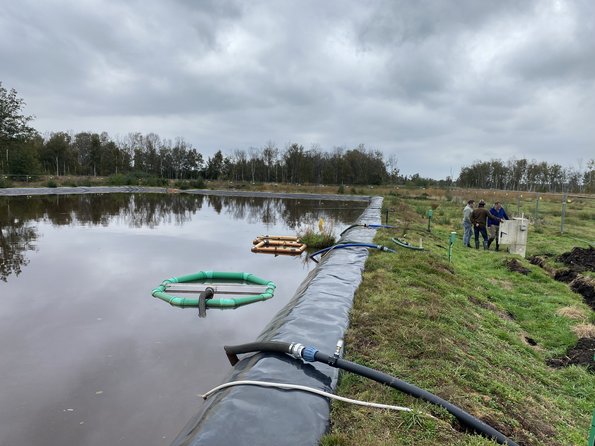
Task 1.1. Establishment of demonstration area comprises levelling and construction of channel infrastructure that ensures correct control of groundwater level (Figure 1). The water level is kept a few cm below terrain all year round.
Task 1.2. Characterisation of Sphagnum species is coordinated by AU-BIO. Focus is on potential donor material from moist areas in the neighbouring field, where Sphagnum has established naturally. Sphagnum in and around the demonstration area will be identified to species level and the importance of Sphagnum cultivation for the area’s biodiversity will be assessed at the end of the project period.
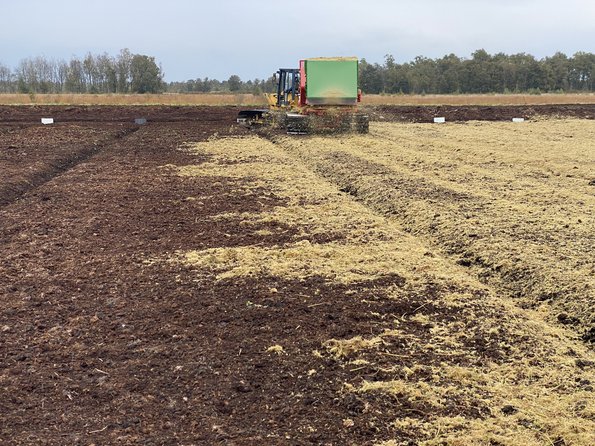
Task 1.3. Sphagnum for spreading (Figure 2). As a starting point, two different Sphagnum types are desired: a) high annual production, b) high nature value. From Sphagnum areas in the neighbouring field, the upper 10 cm are harvested for spreading, which according to Gaudig et al. (2017) also ensures regrowth of the remaining Sphagnum. As an alternative, donor Sphagnum is obtained from areas cultivated with Sphagnum in Germany. Provenances that already exist locally or regionally in Denmark are prioritised. The demonstration plots are supplied with a 10 cm layer of Sphagnum, which is stated as best practice in Gaudig et al. (2017).
This includes optimising harvesting equipment, harvest fresh Sphagnum from demonstration plots (starting approx.. 2028), treating the Sphagnum post-harvest and testing fresh harvested material as an ingredient in growing media.
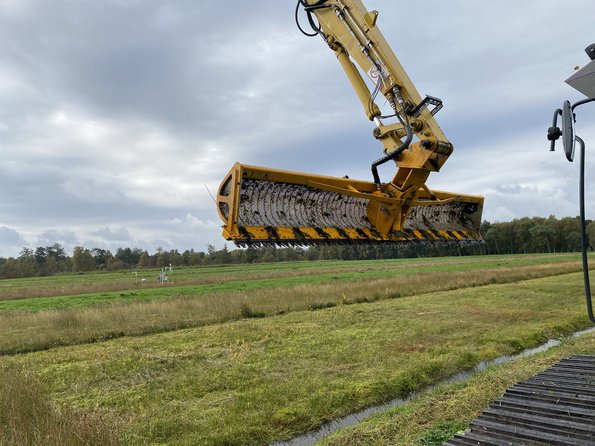
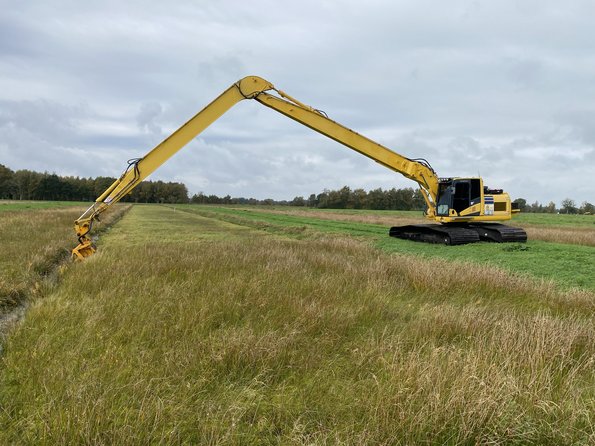
Task 2.1. Optimisation of harvesting equipment. Pindstrup has a suitable backhoe/excavator available, but there is a need partly to extend the arm of the backhoe/excavator, and partly to modify the implement at the end of the arm.
Task 2.2. Harvest of fresh Sphagnum (Figure 3). We expect the demonstration plots are ready for harvest in 2028. Harvest of the upper 10 cm is expected to ensure good regrowth if the water table is adjusted to a few cm below the new surface. Alternatively, fresh Sphagnum will be obtained from areas cultivated with Sphagnum in Germany.
Task 2.3. Post-treatment of the fresh Sphagnum. The fresh Sphagnum will at the time of harvest be very wet, and in order to be able to store the material there is a need for drying/weathering. When the material is dried, it will furthermore obtain significantly better properties for mixing with other raw materials.
This includes an initial characterisation of the area by taking soil samples, installation of water-flow meter and ongoing collection of water samples for analysis, installation of equipment for measurement of atmospheric deposition, nutrient analysis of harvested Sphagnum and any other plants removed during care of the demonstration area. This section also involves the preparation needed for greenhouse gas measurement, along with the biweekly measurements.
Task 3.1. Nutrient balance. Initial characterisation of the area by taking soil samples. Installation of water-flow meter and ongoing collection of water samples for analysis. Installation of equipment for measurement of atmospheric deposition. Nutrient analysis of harvested Sphagnum and any other plants removed during care of the demonstration area.
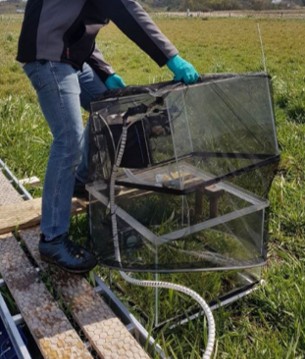
Task 3.2. Prepare measurement of greenhouse gas. Selection of measurement points and establishment of boardwalks. Purchase and installation of base frames (55 cm x 55 cm) for chamber measurements. A total of 20 measurement points are budgeted: 1) 4 frames for each Sphagnum species in the demonstration area, 2) 4 frames in the neighbouring field, 3) 4 frames in the Ringfenner lowland project area at the edge of the area, where measurements are already made with the Eddy Covariance method (ReWet research infrastructure), 4) 4 frames in an area with undisturbed original raised bog (Aaby Mose). Sensors for measurement of explanatory variables are installed at all measurement frames (soil temp., water table, redox potential, air temp.).
The project begins with study trips to Germany and another Nordic country, where areas with Sphagnum for production purposes have already been established. In addition, we will to the greatest extent possible build on the expert knowledge that has been obtained by developing and optimising Sphagnum cultivation in Germany through the past 15 year
Gaudig, G., Krebs, M., Prager, A., Wichmann, S., Barney, M., Caporn, S.J.M., Emmel, M., Fritz, C., Graf, M., Grobe, A., Pacheco, S.G., Hogue-Hugron, S., Holzträger, S., Irrgang, S., Kämäräinen, A., Karofeld, E., Koch, G., Koebbing, J.F., Kumar, S., Matchutadze, I., Oberpaur, C., Oestmann, J., Raabe, P., Rammes, D., Rochefort, L., Schmilewksi, G., Sendzikaite, J., Smolders, A., St-Hilaire, B., van de Riet, B., Wright, B., Wright, N., Zoch, L., Joosten, H., 2017. Sphagnum farming from species selection to the production of growing media: a review. Mires and Peat. 20, 13. https://doi.org/10.19189/MaP.2018.OMB.340.
Rodriguez, A. F., Pullens, J. W. M., Christiansen, J. R., Larsen, K. S., and Lærke, P. E. (2025) Modeling of greenhouse gas emissions from paludiculture in rewetting peatlands is improved by high frequency water table data, EGUsphere [preprint], https://doi.org/10.5194/egusphere-2024-3030.
BioSubstrate 2.0 (https://www.teknologisk.dk/projekter/projekt-udvikling-og-demonstration-af-biobaserede-vaekstsubstrater-biosubstrate-2-0/44201)
