By completing this module, I will be able to
Explore, observe and make self-evaluation of your intercultural competences
Please read the description of two models of development of intercultural competences. Think about how you developed your own set of competences, in which context (time, place, persons, institutions, situation) and describe the sub-competences with which you are more or less familiar. Please use the table below, after the description of two models.
Description of two models of development of intercultural competences In recent decades, numerous definitions of intercultural competences were developed distinguishing different subcompetences. The two definitions within the field that seem internationally to be cited most commonly are Michael Byram’s (1997 and later) model of intercultural communicative competences and Deardorff’s (2006, 2009) grounded research based intercultural competence model. Deardorff, who has established her model on the basis of a delphi-study to reach consensus, emphasises the importance of defining and assessing intercultural competences, while setting clear learning objectives by taking into account the different contexts of intercultural learning situations (Deardorff 2009) (Daryai-Hansen, Jaeger, 2015). |
Byram’s Model
Michael Byram (1997) has developed a theory-based definition of intercultural competence, that distinguishes five subcompetences or savoirs: 1) knowledge (savoirs), 2) attitudes (savoir être), 3) skills of interpreting and relating (savoir comprendre), 4) skills of discovery and interaction (savoir apprendre/faire) and 5) critical cultural awareness/political education (savoir s’engager). Byram describes knowledge and attitudes as “preconditions” (1997:33) for intercultural communication, “although […] they are also modified by the processes of intercultural communication” (ibid.). He places education, concretized as savoir s’engager, “the development of learners’ critical cultural awareness, with respect to their own country and others” (ibid.), in the centre of his model of intercultural competences:
Skills interpret and relate (savoir comprendre) | ||
Knowledge of self and other; of interaction: individual and societal (savoirs) | Education political education critical cultural awareness (savoir s’engager) | Attitudes relativising self valuing other (savoir être) |
Skills discover and/or interact (savoir apprendre/faire) |
In his model of intercultural communicative competence, Byram (1997: 73) distinguishes and interrelates between these five dimensions of intercultural competences on the one hand and communicative competences defined as linguistic, sociolinguistic and discourse competence on the other:
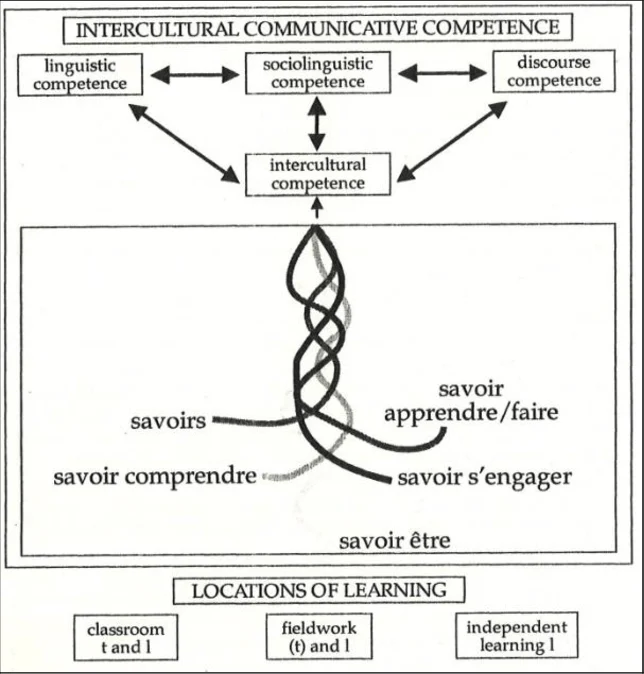
In his model, the context of learning is defined through a specific focus on the educational context and the distinction between three locations of learning: classroom, fieldwork and independent learning” (Daryai-Hansen, Jaeger, 2015).
Think about how you developed your own set of competences, in which context (time, place, persons, institutions, situations) and identify the subcompetences you are more familiar /unfamiliar with +++ or - - -. Ask yourself why.
interpret and relate(savoir comprendre)
of self and other; of interaction: individual and societal (savoirs)
political education critical cultural awareness (savoir s’engager)
relativising self valuing other (savoir être)
discover and/or interact (savoir apprendre/faire)
Explore, observe and make self-evaluation of your intercultural competences
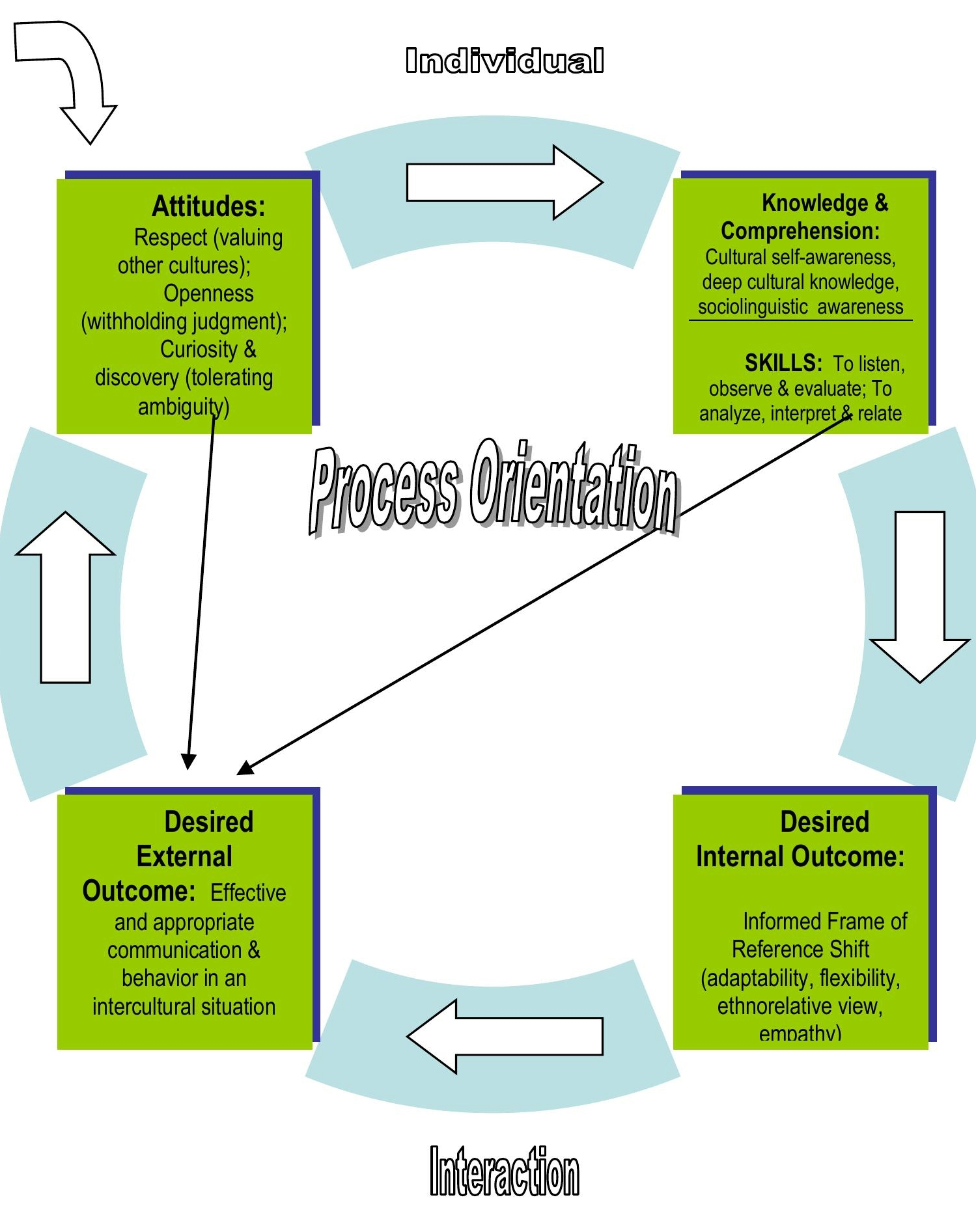
Deardorff’s Model Darla Deardorff has developed her model of intercultural competences based on grounded research. Through a Delphi-study, she has reached consensus among primarily US-American specialists within the field, how intercultural competences should be defined. Deardorff has elaborated several visualisations of her definition. In the following we will present her process model of intercultural competence. Deardorff’s model Deardorff (2006, 2009) establishes a dynamic, hierarchic, long-life cycle of developing intercultural competence:
In Deardorff’s model, attitudes are at the foundation of intercultural competences (cluster 1). They are the starting point and defined as enhancing respect (valuing other cultures, cultural diversity), openness (to intercultural learning and to people from other cultures, withholding judgment), curiosity and discovery (tolerating ambiguity and uncertainty). At a second stage (cluster 2), Deardorff positions knowledge & comprehension and skills (Daryai-Hansen, Jaeger, 2015). Deardorff subsumes knowledge & comprehension as one subgroup enhancing cultural self-awareness, deep understanding and knowledge of culture (including contexts, role and impact of culture & others’ world views), culture-specific information and sociolinguistic awareness. Deardorff approximates knowledge & comprehension and skills, defining skills as the ability to listen, to observe and interpret, to analyse, to evaluate and relate (Daryai-Hansen, Jaeger, 2015). In cluster 3, subsuming “internal outcome” and “external outcome”, Deardorff puts emphasis on the interaction and shows “the movement from the personal level to the interpersonal level (intercultural interaction)” (Deardorff 2006a, 257) in (Daryai-Hansen, Jaeger, 2015). Deardorff points out that the internal outcomes enhance adaptability, flexibility, empathy and an ethnorelative view. Thanks to these elements, individuals are able to put their frame of reference into question, to shift it and to adjust or extend it by emotionally internalizing other values (Daryai-Hansen, Jaeger, 2015). That leads or might lead to a change of behaviour, which is observable in external outcomes described as “behaving and communicating appropriately and effectively in intercultural situations” (Deardorff, 2006b). The appropriateness corresponds to “the avoidance of violating valued rules” and effectiveness is the achievement of valued objectives (Daryai-Hansen, Jaeger, 2015). Deardorff’s model emphasises the idea that the acquisition of intercultural competence is a dynamic, continuous process that enhances diverse dimensions depending on the context and the interaction.” (ibid.) |
Tink about how you developed your own set of competences, in which context (time, place, persons, institutions, situations) and identify the subcompetences you are more familiar /unfamiliar with +++ or - - -. Ask yourself why.
Attitudes are at the foundation of intercultural competences. They are the starting point and defined as enhancing respect (valuing other cultures, cultural diversity), openness (to intercultural learning and to people from other cultures, withholding judgment), curiosity and discovery (tolerating ambiguity and uncertainty) (Daryai-Hansen, Jaeger, 2019). Your reflection on your attitudes:
Knowledge & comprehension as one subgroup enhancing cultural self-awareness, deep understanding and knowledge of culture (including contexts, role and impact of culture & others’ world views), culture-specific information and sociolinguistic awareness. Knowledge & comprehension and skills, defining skills as the ability to listen, to observe and interpret, to analyse, to evaluate and relate. (Daryai-Hansen, Jaeger, 2015). Your reflection on your knowledge and skills:
“internal outcome” and “external outcome” subsumed, emphasis on the interaction and “the movement from the personal level to the interpersonal level (intercultural interaction)” (Deardorff 2006a, 257). The internal outcomes enhance adaptability, flexibility, empathy. Individuals are able to put their frame of reference into question, to shift it and to adjust or extend it by emotionally internalizing other values. That leads a change of behaviour, which is observable in external outcomes. (Daryai-Hansen, Jaeger, 2015). Your reflection about your internal outcomes
External outcomes described as “behaving and communicating appropriately and effectively in intercultural situations” (Deardorff, 2006b)
Please describe your continuous process of the acquisition of intercultural competences (self evaluation of your process and your progress)
Autobiography of Intercultural Encounters
This activity will help you demonstrate an awareness and sensitivity to different cultural contexts at an increasingly internationalised labour market.
Please familiarize you with the Autobiography of intercultural encounter (AIE) here: https://rm.coe.int/autobiography-of-intercultural-encounters/16806bf02d
As part of your reflection on intercultural experiences, you are invited to complete the Autobiography of Intercultural Encounters (AIE). This will help you explore and understand how you experienced cultural diversity in a meaningful way.
Please follow these steps:
1. Choose your perspective Select one of the following perspectives to frame your reflection:
Think of a specific moment or interaction during that experience where you encountered someone from a different cultural background than your own. |
2. Describe the encounter In the AIE form, describe:
Be as specific as possible. Focus on a single event or interaction. |
3. Reflect on your feelings and reactions Consider:
Try to be honest and open in your reflection. |
4. Analyze the cultural dimensions Think about:
|
5. Conclude with insights Wrap up by reflecting on:
|
Culture and intercultural understanding are not something you learn once and for all — they grow throughout life through experiences, encounters and reflection. Every conversation, collaboration or new environment gives you the chance to listen, observe, understand and see things from different perspectives.
Developing cultural and intercultural competences means becoming more open, curious and confident in diverse situations. It helps you navigate complexity, connect with others and better understand both the world around you and your own place within it. The important thing is not only what you experience, but also how you reflect on those experiences and learn from them.
At the end of this capital, take a moment to reflect. Learning is not just about gaining knowledge — it's about recognising what you can do with it and what you still want to develop. Use the questions below to capture your personal takeaways and map out your next steps.
Identify key insights from this capital.
Think about my current skills and strengths.
Define my future learning goals and strategies.
This short reflection helps you to:
You can fill this out independently or use it in conversations with a career adviser, academic mentor or peer group. Over time, your responses will help you see the full scope of your language-related employability profile.