Aerosols and their interactions with clouds remain the largest source of uncertainty in predicting climate change at the regional scale. They influence how sunlight is reflected or absorbed, and how clouds form, evolve, and produce rain. Because aerosols respond rapidly to emission changes, reducing Aerosol-Cloud Interaction uncertainty is essential to guide effective climate action and ensure that clean-air policies also deliver climate benefits.
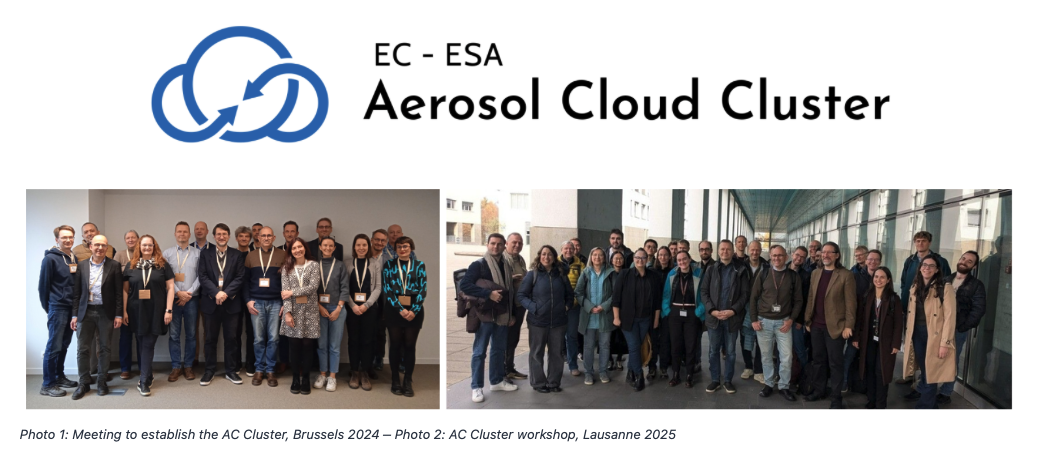
The EC–ESA Aerosol Cloud Cluster brings together Europe’s leading experts in this field, linking the two EU-funded projects CleanCloud and CERTAINTY as well as other ESA-funded initiatives such as AIRSENSE. All three initiatives share the same overarching objective: enhancing our understanding of aerosol–cloud interactions to improve climate predictions and mitigation strategies. Together, they involve more than 220 researchers from nearly 40 institutions, fostering an unprecedented level of collaboration.
By combining state-of-the-art observations and modelling, the cluster strengthens Europe’s capability to assess climate risks, improve predictions, and guide effective climate policies and adaptation strategies for the benefit of communities across Europe and beyond.
These collaborations amplify research impact, consolidate the European and international ACI research community, and lay the groundwork for future programmes, models, and missions. Long-term legacy is embedded through a comprehensive exploitation strategy and strong alignment with major research infrastructures such as ACTRIS, as well as enhanced policy engagement, broader dissemination, continuous training, and strategic partnerships.
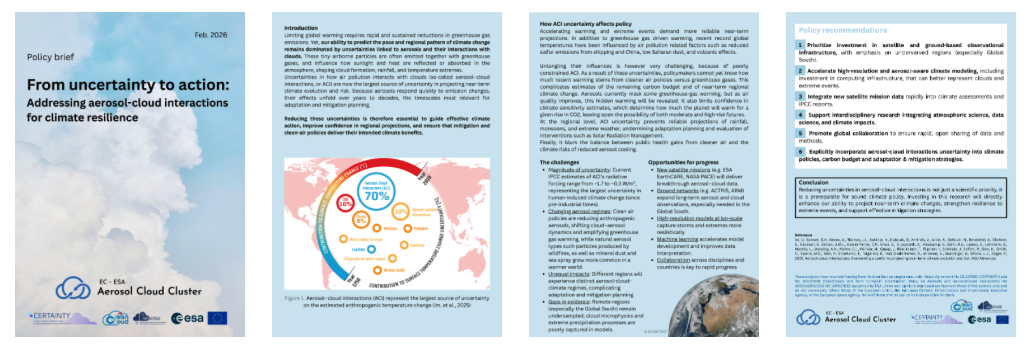
Based on Im et al. (2026) new publication (see below), a policy brief directed towards European policymakers stresses the need to invest in research to reduce uncertainties in aerosol-cloud interactions to enhance the ability to project near-term climate changes, strengthen resilience to extreme events and support effective mitigation strategies.
Uncertainties in how air pollution interacts with clouds (so-called aerosol–cloud interactions) are now the largest source of uncertainty in projecting near-term climate evolution and risk. Because aerosols respond quickly to emission changes, their effects unfold over years to decades, the timescales most relevant for adaptation and mitigation planning.
Reducing these uncertainties is therefore essential to guide effective climate action, improve confidence in regional projections, and ensure that mitigation and clean-air policies deliver their intended climate benefits.