
Co-curating Topographic Imaginaries
Emmy Laura Pérez Fjalland's new postdoc project
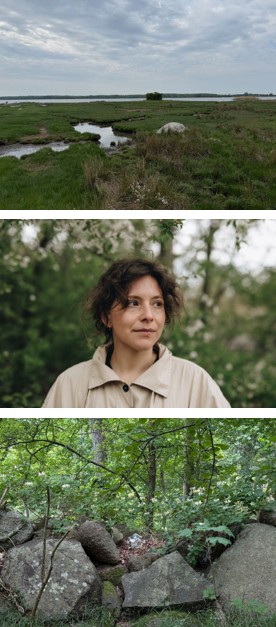
This spring Emmy Laura Pérez Fjalland – a geographer and planner that has been affiliated to the ANTHEA research project on and off since 2021 – started a three-year postdoc at Fuglsang Art Museum and Section for Landscape Architecture and Planning at Copenhagen University, funded by the New Carlsberg Foundation.
With the project ‘Co-curating Topographic Imaginaries’ Emmy Laura will continue her research in heritage landscapes, environmental futures and storytelling – although ‘moving’ the geographical attention from the Atlantic heaths to the region of Guldborgssund, a sound running between two Danish islands in the Baltic Sea.
As seen with the heathlands, visual arts have previously played an important role in creating ideal Danish topographies, and today artists are rethinking the rural landscape in response to, for example, climate change, colonialism, environmental destruction and capitalism. Fuglsang Art Museum has a long history of focusing on landscapes, making it an ideal site to query into what new topographic imageries might be emerging.
The region is characterised by islands and peripheries (as the remaining heaths) and hold thick histories of Peasant Stone Age and Bronze Age, wetlands and riverine landscapes, forest and coastal cultures, deadly floods from the Baltic Sea, international seatrade, fruit plantation and industrial farming, drainage and damming. In the coming years the region – and Denmark – is going to implement, what could potentially be the largest land reform in 250 years.
With this project, Emmy Laura will query into what kind of landscapes are being imagined and initiated; how these future landscapes might feel to live in and for whom; what roles humans could play in these lands, and what we might learn from past practices of landscaping in the region.
She will make use of both landscape analysis, sensory ethnography, involve the museum's collection and conduct collaborative methods with local ‘land’ actors. Because research in landscape transition and transformation have shown that there is also a need for historical perspectives, sensory and affective future knowledge in addition to STEM-based future knowledge.
The aim is to investigate spatial aspects of living with ‘uncertainty’ and ‘variability’, unfold different landscape imaginaries, and query into how museums and aesthetic practices could contribute to future landscape planning.