
1 year, 75 ECTS, a full MSc Degree
The Master's degree program in Applied Data Analytics is a research-based program focusing on the application of modern data analytical and data science methods to scientific problems. The programme is designed for students with a natural sciences background who want to develop advanced competencies in data analysis within a specific scientific domain.
The program combines methodological training in data science with applications in real-world scientific contexts. Students learn how to work with the entire data analysis pipeline, from data collection and cleaning to visualization, modelling, interpretation, and communication of results. The final 15 ECTS master's thesis is typically embedded in a research project and carried out in collaboration with a scientific research group or, in some cases, an external company.
The degree program is academically structured around programming, statistics, machine learning, data visualisation, linear transformations, mathematical modelling, and the application of data science methods within natural science disciplines. Students develop both theoretical understanding and practical experience in applying advanced analytical methods to complex datasets.
The study overview below shows the layout of the program's mandatory courses and other degree elements.
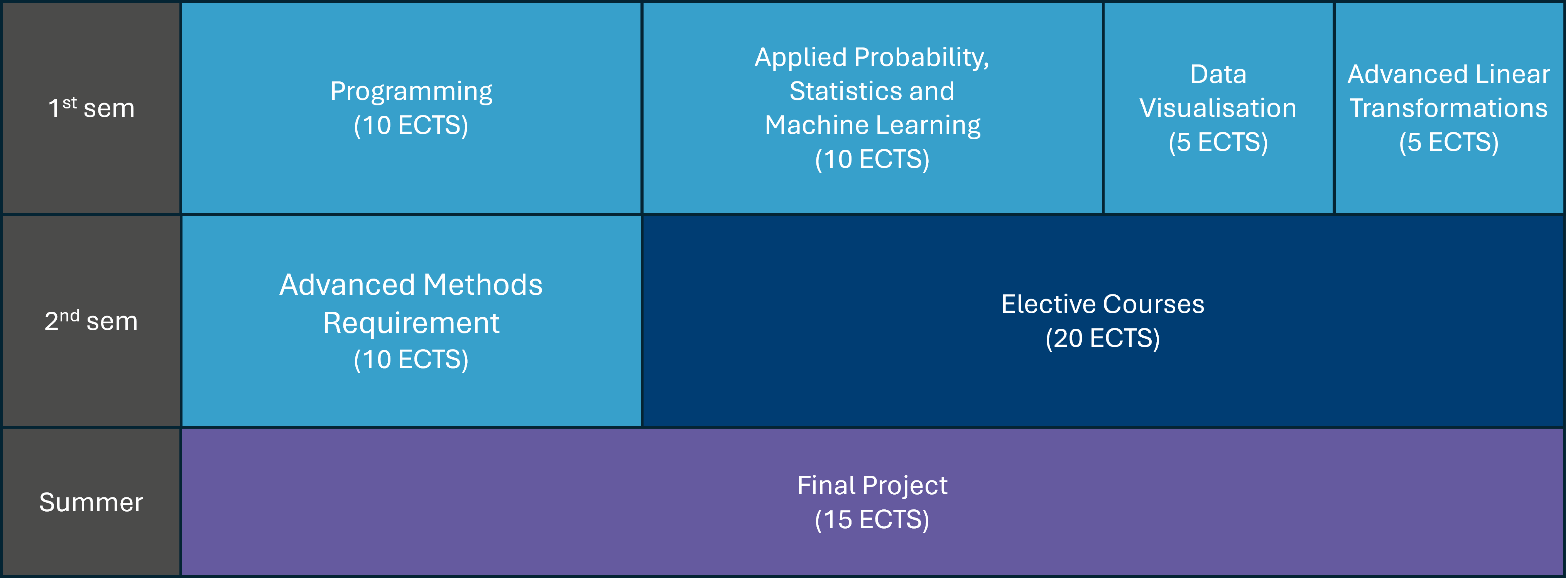
The degree program consists of a total of 75 ECTS and is composed of the following elements:
Standard programming languages, fundamental programming concepts, basic data structures, debugging, testing, and software development with object-oriented programming.
Topics in probability theory, likelihood methods, Bayesian statistics, regression, classification, and neural networks, providing the statistical foundation for modern data analysis.
Principles of visual communication of data, design of data visualisations, critical interpretation of graphical presentations, and foundations of interactive visual analytics.
Matrices, eigenvalues and eigenvectors, spectral analysis, numerical linear algebra, and applications such as differential equations and singular value decomposition.
An advanced elective course chosen in consultation with the programme director, intended to build upon the methods learned during the autumn semester. The selected advanced methods course may be chosen from the list of elective courses below or may consist of an advanced course in mathematics or data science.
Examples include Stochastic Processes (10 ECTS), Cluster Analysis (10 ECTS)
Individual students tailor part of their degree program through elective courses. Courses are selected together with the programme director to ensure academic coherence between methodological competencies, the chosen scientific application area, and the master's thesis. Examples include:
To complete the degree program, you must write a 15 ECTS master's thesis. The thesis gives you the opportunity to apply modern data science methods to a relevant scientific research problem and demonstrate independent analytical work.
The thesis is carried out within a scientific research project and is supervised by both a methodological supervisor from the Department of Mathematics or the Department of Computer Science and a project supervisor from the relevant research group or collaborating organisation.
Topics may involve the application of advanced methods in statistics, machine learning, optimisation, programming, modelling, or data visualisation within disciplines such as biology, physics, chemistry, geoscience, molecular biology, health sciences, or industry-based projects.
Through the thesis, students demonstrate their ability to identify, analyse, and solve a complex scientific problem using modern data analytical methods. The final thesis constitutes the concluding element of the degree program and is weighted 15 ECTS.
For details about admission requirements, student life, and practical information, see the official page on masters.au.dk/ (button below).
