
1 year, 75 ECTS, then you have Master of Science degree
The Master's degree program in Science Communication (aka. SciComm) is a research-based program built on a foundation in natural sciences, providing advanced competencies in the analysis, planning, and execution of communication within science and technology.
The program is both theoretical and practice-oriented. As a student, you will get hands-on experience testing various methods within science communication. Assessments will primarily be portfolio-based, and special emphasis is placed on making the 15 ECTS final thesis part of a collaboration with an external partner (for example, a company or institution). This could be some of the partners described in the sub-menu on the left, or whatever appeals to you and the way you want to communicate science.
The degree program is academically structured around science communication and adjacent fields such as philosophy of science, research ethics, history of science, sociology of science, and research bibliometrics. Students gain knowledge about how scientific knowledge is developed, communicated, and applied in society, and learn to translate complex knowledge into targeted communication across media and audiences.
The study overview below shows the layout of the program's mandatory courses and other degree elements.
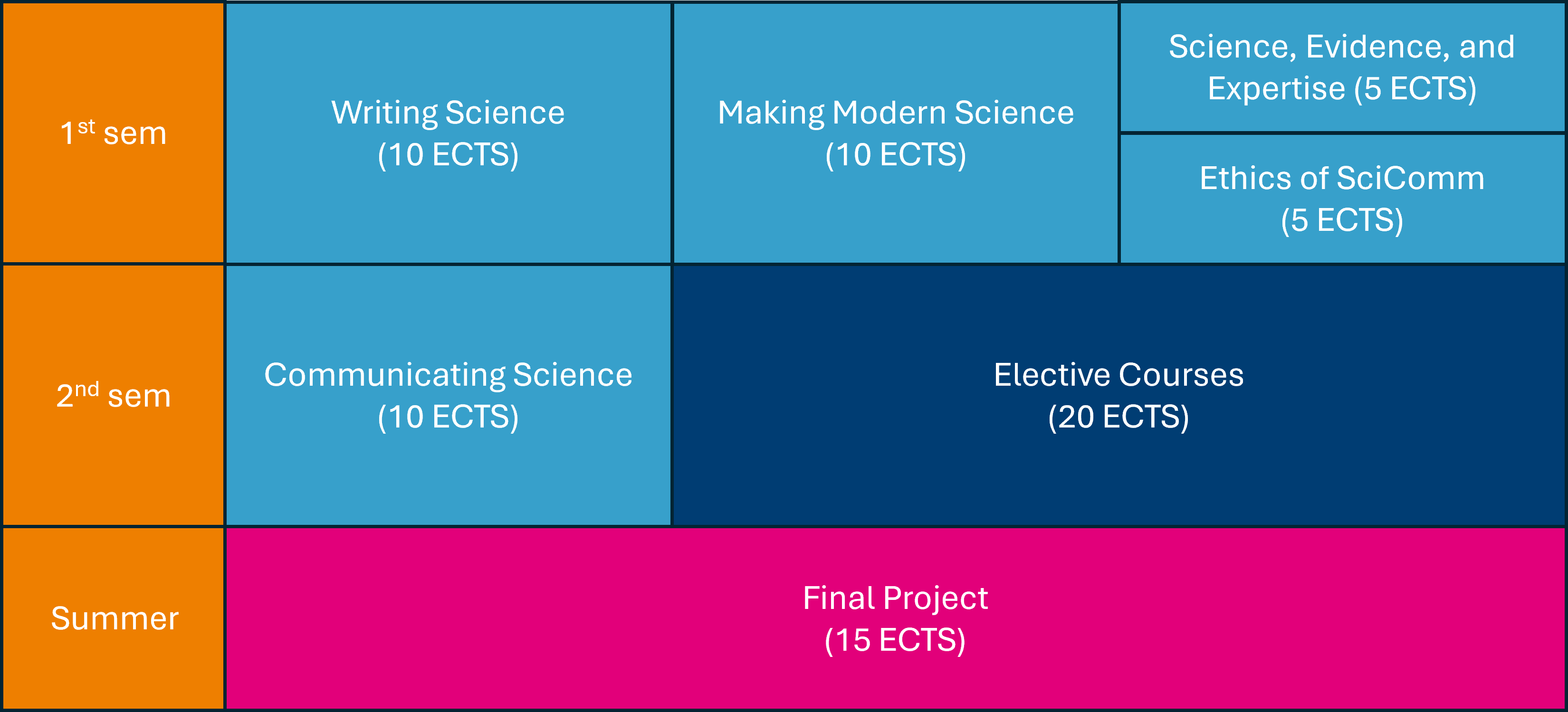
The degree program consists of a total of 75 ECTS and is composed of the following elements:
Tools and methods for written communication of natural science through various genres and media.
Advanced philosophy of science, demarcation of pseudoscience and unreliable research, scientific communication and research evaluation, as well as key concepts and issues in the philosophy of science.
The emergence of modern natural science with a focus on the development of methods, insights, and the interaction with surrounding society.
Research ethics and responsible scientific communication, evidence-based science communication, advisory work and policy-making, as well as reflection on one's own practice as a science communicator.
Tools and methods for multimedia communication of science, including podcasts, exhibitions, infographics, games, digital platforms, public lectures, and other outreach activities.
Individual students tailor part of their degree program through elective courses. Examples of options include:
To complete the degree program, you must write a 15 ECTS thesis. The final project gives you the opportunity to immerse yourself in a self-chosen topic within science communication and apply the theories, methods, and perspectives you have gained throughout the program. Preferably in collaboration with an external partner.
The project can be based on topics such as science communication, research communication, philosophy of science, research ethics, or the interaction between research and society.
Through your work on the thesis, you demonstrate your ability to identify, analyze, and discuss an academic issue at a master's level as well as communicate your results clearly and systematically.
The final thesis constitutes the concluding element of the degree program and is weighted 15 ECTS. It is written in the period immediately following the end of the 2nd semester up until August.
For details about requirements, the student life, and more, see the official page on kandidat.au.dk (button below).
